The internet borrowed the -maxxing suffix from the looksmaxxing crowd and bolted it onto everything. Sleepmaxxing, dopaminemaxxing, and now tokenmaxxing. So when people hear the word, they assume it means the obvious thing: pour the maximum number of tokens into the model. Dump the whole repository into the context window. Paste the entire PDF. Buy the million-token tier and use every last one of it.
That is not tokenmaxxing. That is just spending money. The real thing is sneakier.
The metric that ate the others
We used to count lines of code. Then we counted commits. Then tasks closed. And now — tokens.
And if there’s a metric, there’s a way to inflate it. That’s how tokenmaxxing was born.
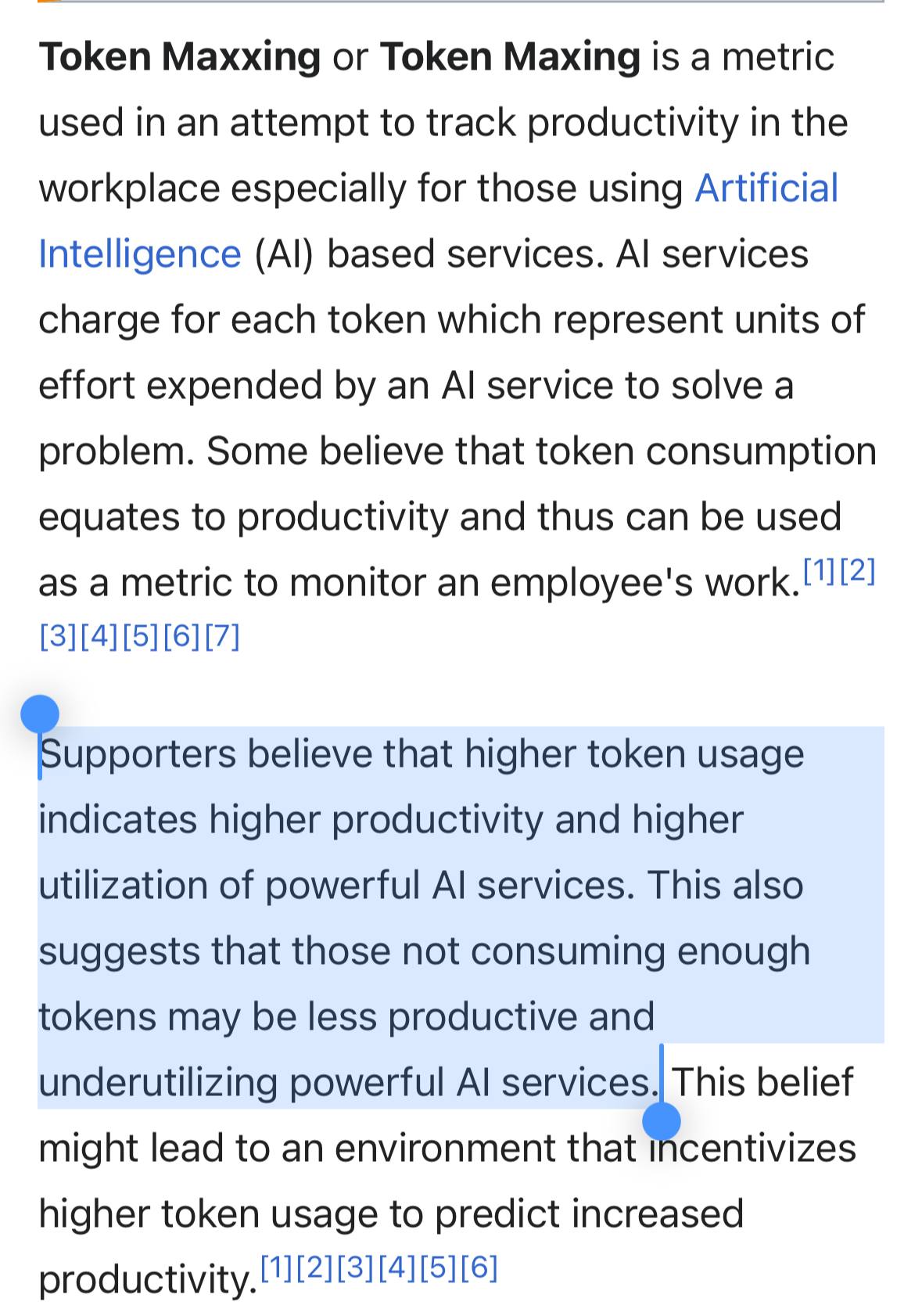
Tokenmaxxing is when a developer maximizes the number of tokens they burn in order to climb the leaderboard. The manager’s leaderboard. The company dashboard, where you light up as “AI activist of the month.” Whatever scoreboard someone decided to wire up to the API bill and mistake for productivity.
Programmers love a leaderboard. First, because it has sorting — and sorting is cool. Second, because it’s a simple, legible instrument, satisfying to grind up like XP in a game. Give an engineer a number that goes up and a column that ranks them against their peers, and you have built a slot machine. It doesn’t even matter much what the number measures. The number going up is the reward.
So the moment “tokens consumed” lands on a dashboard, someone, somewhere, starts feeding the model padding to win a contest nobody should be running.
The other misconception
The intuition is seductive. Context windows keep growing — 200K, then 1M, then more. So the natural move is to treat the window like a bucket and fill it to the brim. More context means more information means better answers, right?
In practice this is where most people’s results get worse, not better. Three things happen:
- Cost scales linearly with garbage. Every irrelevant token you ship is billed, on every single turn of a conversation. A bloated prompt isn’t a one-time cost — you pay rent on it for the whole session.
- Latency scales too. Prefill is not free. A prompt that is 90% noise still has to be read in full before the first output token appears.
- Attention gets diluted. The “lost in the middle” effect is real. Burying the one paragraph that matters inside 400K tokens of context doesn’t help the model find it — it helps the model lose it.
So the person who “maxxes tokens” by stuffing the window ends up slower, more expensive, and less accurate. They optimized the wrong number.
What tokenmaxxing actually is
Tokenmaxxing is getting the maximum value out of every token — input and output. It’s a discipline of scarcity, not abundance. The same instinct a backend engineer has about bytes on the wire or rows scanned in a query, applied to the context window.
Treat tokens like you treat a database. You don’t SELECT * from a billion-row table and filter in the application. You push the predicate down, fetch the columns you need, and let the index do the work. Tokenmaxxing is SELECT with a WHERE clause for LLMs.
A few things that follow from this framing:
Curate, don’t dump
Retrieval beats stuffing. Pulling the five most relevant functions into context will outperform pasting the whole codebase almost every time — cheaper, faster, and more accurate because the signal isn’t drowned. The skill is in the selection, not the volume.
Spend tokens where they pay off
Not all tokens are equal. Tokens spent on the model thinking — reasoning, planning, working through a hard problem step by step — frequently earn their keep many times over. Tokens spent re-pasting boilerplate the model has already seen do not. Tokenmaxxing means moving your budget from the second category to the first.
Compress the boring parts
Long-running agents and chat sessions accumulate history. The naive approach keeps every turn verbatim forever. The tokenmaxxed approach summarizes settled context, drops resolved tangents, and keeps the window dense with what’s still live. A good summary of ten turns can carry the same decision-making weight as the raw transcript at a fraction of the cost.
Cache what repeats
If you send the same large system prompt or the same document on every request, you’re paying full price for tokens the provider already processed. Prompt caching turns that repeated prefix into a cheap lookup. The tokens are still “there” — you’ve just stopped paying full freight for them. This is the closest thing to a free lunch in the whole space, and most people leave it on the table.
The mental model
Here’s the reframe that makes it click. The amateur asks:
How many tokens can I fit?
The tokenmaxxer asks:
What is the smallest, densest set of tokens that gets me the result I want?
It’s the difference between a junior who throws more hardware at a slow service and a senior who profiles it and fixes the one N+1 query. The constraint isn’t the size of the window. The constraint is your attention to what goes in it.
Bigger context windows didn’t make this discipline obsolete. They made it more valuable, because now there’s enough rope to really hurt yourself.
Closing thought
So no — tokenmaxxing is not about using more tokens. It’s about respecting them. The window is a scarce, expensive, attention-limited resource, and the engineers who win are the ones who treat it that way.
Same lesson we learned with memory, with bandwidth, with database calls. The resource changed. The instinct that matters didn’t.
And if your dashboard rewards the opposite — if the path to “AI activist of the month” runs through burning the most tokens — then congratulations, you’ve built an incentive to be wasteful and called it innovation.
So, two questions. Do you have tokenmaxxers at your company? And how deep is your company in the AI fever?